
 Measurements: Length 24-26 cm. Wingspan 38-40 cm, hence the largest Dendrocopos woodpecker in Europe, some 2-3 cm longer than Great Spotted and Syrian Woodpeckers. White-backed is not a difficult woodpecker to identify once found, usually immediately appearing to be rather long-necked and long-billed. The nominate leucotos race is described here (lilfordi in another post). Birds do indeed have a white upper-rump and lower-back but they are not as “white-backed" as their name suggests. The upper back is glossy black and the white on the back below this is sometimes obscured and difficult to see. Rather, it is the white barred coverts, particularly the upper broad white bar of the median coverts that are seen. When a bird takes flight the large white area composed of the lower scapulars, lower back and upper rump comes into view. In most cases this white area is crescent-shaped and connects with the uppermost wing bars. However, on some birds this white area is only slightly broader than the white upper-wing bars. The amount of white on the lower back also varies. There can also be significant variation between birds in the shape and extent of their white back. Individual plumage variations can sometimes exist between populations and sometimes within them. The wings are black but dotted with white on the greater coverts. The flight feathers are crossed by rows of large white spots that almost form bars. White bars on the upper-wing, are often obscured by the white back patch, which sometimes forms a broad fringe across the back. The broad white bar on the upper-wing is striking when in flight and on perching birds seen from side. On a rear view heavy white barring can be seen to extend across the closed tertials (unlike Great Spotted and Syrian). The scapulars are glossy black. The upper-tail coverts and most of the rectrices are black. The outer rectrices are white with thin black barring. The ventral region and under-tail coverts are pink, never red, and not strongly demarcated from the whitish belly (as Great Spotted). The pink extends up and merges into the lower belly and sometimes colours the flanks and leg feathering (as Middle Spotted). Under-parts are white or cream, but often with a yellowish hue. Long black streaks cover the flanks, and sides of the breast and belly (as Middle Spotted). Despite having pink and yellow areas on the under-parts, White-backed Woodpecker always shows much white in flight. The face pattern can vary slightly from bird to bird but typically the black malar stripe starts from the lower mandible (unlike Middle Spotted) and meets the post-auricular stripe on the side of the neck to form a black T-junction. From here a black stripe runs down to the sides of the neck and onto the upper breast, and below this the black flank streaking is strongest. The post-auricular stripe runs over and across the ear-coverts towards the nape, but not touching it (like Syrian and Middle Spotted but unlike Great Spotted). Face, chin and throat are all white but buff behind the eye. On a rear view a black linking stripe from black nape down to glossy black mantle can be seen (recalling Middle Spotted). The forehead and lores are greyish. The bill is grey, long and very thin at the tip, the iris reddish brown and the legs and toes grey. The photo here is of an adult male leucotos race, taken in the Bükk Hills, Hungary (László Nehézy).
Friday, 14 September 2007
White-backed Woodpecker: general ID
Measurements: Length 24-26 cm. Wingspan 38-40 cm, hence the largest Dendrocopos woodpecker in Europe, some 2-3 cm longer than Great Spotted and Syrian Woodpeckers. White-backed is not a difficult woodpecker to identify once found, usually immediately appearing to be rather long-necked and long-billed. The nominate leucotos race is described here (lilfordi in another post). Birds do indeed have a white upper-rump and lower-back but they are not as “white-backed" as their name suggests. The upper back is glossy black and the white on the back below this is sometimes obscured and difficult to see. Rather, it is the white barred coverts, particularly the upper broad white bar of the median coverts that are seen. When a bird takes flight the large white area composed of the lower scapulars, lower back and upper rump comes into view. In most cases this white area is crescent-shaped and connects with the uppermost wing bars. However, on some birds this white area is only slightly broader than the white upper-wing bars. The amount of white on the lower back also varies. There can also be significant variation between birds in the shape and extent of their white back. Individual plumage variations can sometimes exist between populations and sometimes within them. The wings are black but dotted with white on the greater coverts. The flight feathers are crossed by rows of large white spots that almost form bars. White bars on the upper-wing, are often obscured by the white back patch, which sometimes forms a broad fringe across the back. The broad white bar on the upper-wing is striking when in flight and on perching birds seen from side. On a rear view heavy white barring can be seen to extend across the closed tertials (unlike Great Spotted and Syrian). The scapulars are glossy black. The upper-tail coverts and most of the rectrices are black. The outer rectrices are white with thin black barring. The ventral region and under-tail coverts are pink, never red, and not strongly demarcated from the whitish belly (as Great Spotted). The pink extends up and merges into the lower belly and sometimes colours the flanks and leg feathering (as Middle Spotted). Under-parts are white or cream, but often with a yellowish hue. Long black streaks cover the flanks, and sides of the breast and belly (as Middle Spotted). Despite having pink and yellow areas on the under-parts, White-backed Woodpecker always shows much white in flight. The face pattern can vary slightly from bird to bird but typically the black malar stripe starts from the lower mandible (unlike Middle Spotted) and meets the post-auricular stripe on the side of the neck to form a black T-junction. From here a black stripe runs down to the sides of the neck and onto the upper breast, and below this the black flank streaking is strongest. The post-auricular stripe runs over and across the ear-coverts towards the nape, but not touching it (like Syrian and Middle Spotted but unlike Great Spotted). Face, chin and throat are all white but buff behind the eye. On a rear view a black linking stripe from black nape down to glossy black mantle can be seen (recalling Middle Spotted). The forehead and lores are greyish. The bill is grey, long and very thin at the tip, the iris reddish brown and the legs and toes grey. The photo here is of an adult male leucotos race, taken in the Bükk Hills, Hungary (László Nehézy).

Middle Spotted Woodpecker: races ID
The nominate race, medius, occurs in Europe though birds on the Greek island of Lesvos may belong to the anatoliae race which breeds on the nearby Turkish mainland. Anatoliae is slightly smaller and more heavily marked on the flanks and breast than medius. But generally differences in size and colour are clinal. As a rule populations in northern and central Europe are larger and paler than in the Balkans and Mediterranean zone.
Middle Spotted Woodpecker: juvenile ID
Black areas of plumage on juvenile Middle Spotted Woodpeckers are less glossy than on adults. Recently fledged birds have brownish greater wing coverts whereas adults have totally black greater wing coverts. White areas of wing-coverts and scapulars have brownish marks. White upper-parts are buffer with some brownish feather tips. White under-parts are greyish rather than yellowish. White on face smudged with grey. Red crown is duller and mottled with grey feather tips. Some red feather tips on hind-crown. Under-tail is a paler, washed out pink and the coloured area is smaller than on adults, not reaching the belly. Some fine, thin barring on flanks, not as heavy markings as adults. Eye grey-brown (in adult dark red). When crown raised, feathers are visibly shorter than on adult. Vent and under-tail coverts washed out, pale pink. Juvenile male have smaller and duller red crowns than adults and the red is flecked with grey or black feathers, especially at the rear and sides. Juvenile females look like juvenile males except the pale red crown patch is often shorter and smaller and the hind-crown is grey-black not golden as adult female. However, many juveniles will be difficult to sex in the field.
Middle Spotted Woodpecker: adult female ID
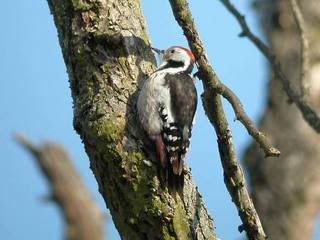 Female Middle Spotted Woodpeckers are very similar to males in plumage. They, too, have a red crown but it is not as bright as on males and does not extend as far back towards the nape. The red is also lighter, sometimes perhaps orange or rusty brown at the rear. The white forehead is often tinged yellow. But these features are generally difficult to judge in the field and may be so slight that they are unreliable, except on close-up views in the breeding season. On this photo of a female, taken at Kamond in Hungary (Gábor Vasuta), the red crown peters out at the rear and is rather dull. The flanks are not as well marked with black as on males, either.
Middle Spotted Woodpecker: adult male ID
 Adult male Middle Spotted Woodpeckers have a bright, strong red crown. In the breeding season the red feathers jut out at the rear almost like a crest. On average males are also larger and heavier than females and have slightly longer bills. But these factors are not useful in the field. Even though at a distance the complete bright red crown that extends to the very rear, and which is typical of males, can be seen. Photo taken at Doba in Hungary (Gábor Vasuta).
Middle Spotted Woodpecker: general ID
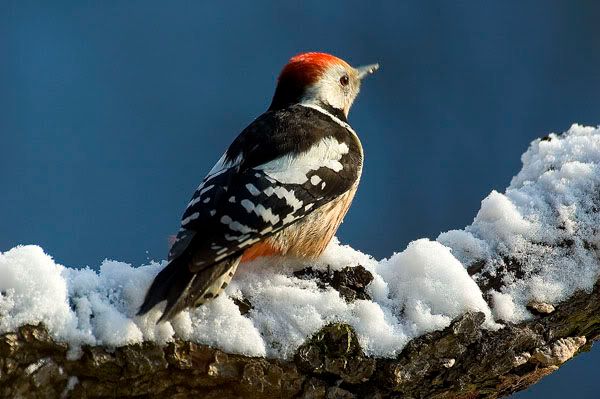 Measurements: Length 20-22 cm. Wingspan 33-34 cm. Despite its vernacular and scientific names Middle Spotted Woodpecker is not mid-way in size between its Dendrocopos relatives, the smaller Lesser Spotted and larger Great Spotted and Syrian. Middle Spotted is much closer to the two larger species in all measurements, being just 15% smaller, but is around 40% larger than Lesser Spotted. Middle Spotted differs from all its European relatives in being almost totally monomorphic, i.e. males and females are almost identical in appearance. Differences between the sexes will be dealt with in other posts in this blog. Both adults are essentially black and white although the white areas are rather dusky. Middle Spotted Woodpecker has less black on the face than other Dendrocopos species. Indeed, the cheeks, ear-coverts, forehead, chin, throat, neck and upper breast are all shades of off-white with a cream, buff or grey tinge. Lores and nasal tufts grey. There is only the suggestion of a malar stripe and on some birds it may be lacking altogether. Even when a malar is present it never starts from the lower mandible, but rather begins a little way short. In this respect it differs from all other European Dendrocopos species. The ear-coverts are creamy white, often rather dusky, and are crossed only partially by a black post-auricular stripe. The extent that the post-auricular stripe crosses the ear-coverts varies, but it never meets the black nape. However, on some views, particularly when birds are twisting their head during foraging, it may seem that the post-auricular stripe touches the nape. The iris is dark red, but usually appears black, and stands out as a dark bead in the otherwise pale face. An isolated black crescent-shaped area is formed below the cheek on the side of the neck where the base of the post-auricular stripe, whatever malar stripe there is and the shoulder stripe meet. The shoulder stripe runs by the side of the throat down to the upper sides of the breast where it merges into black streaks on the upper flank. The thin black line down back of neck linking the crown to the mantle recalls Syrian rather than Great Spotted as there are no post-auricular stripes joining it at the sides. The dark eye is clearly isolated in the white side of the face. Both adults have a red crown bordered by the white of the face. The lower breast, belly and flanks are essentially creamy white though this varies from dirty white to buff and there are often distinct yellowish tones on the flanks, belly and sometimes the breast. This yellowish wash may reach the leg feathering on some birds. The extent and strength of yellow is very variable. The lower belly, under-tail coverts and ventral area are flushed with pink. This pink spreads higher up the under-body than similar colouration does on other pied woodpeckers. It is also always paler than the red of the crown (recalling Syrian rather than Great Spotted). The flanks are heavily streaked with long black lines (recalling White-backed). The mantle, inner scapulars, back, rump and upper tail coverts are matt black. The outer scapulars are creamy white and form ovals, similar to but smaller than, those of Syrian and Great Spotted. The primaries and secondaries are black, heavily dotted and barred with white. Some of the rows of white spots on the flight feathers almost join to form bars. The upper wing-coverts are black and the inner median wing-coverts white with black bases. The greater coverts are black with white tips. The axillaries are dusky or dirty white. Most of the tail is black though the outer two rectrices are white dotted with 2 or 3 black bars (recalling Great Spotted rather than Syrian) whilst the third rectrix is sometimes edged white. The bill is visibly small and weak, mostly grey but with the lower mandible paler. The legs are grey. Males and females overlap in all measurements and features, but all size differences are rather subtle and slight and probably more related to feeding and foraging behaviour than to visual recognition. This photo of an adult male, showing most of the classic ID features, was taken in northern Hungary (László Nehézy).
Thursday, 13 September 2007
Woodpecker signs: ringing
Ringing is a series of small, more or less horizontal, holes or grooves which woodpeckers peck around a trunk in order to get at and drink sap. Ringing is sometimes referred to as “girdling" and the peck marks called wells. Ringing is less common amongst European woodpeckers than it is, for example, amongst North American species: there are no true sapsuckers in Europe. Great Spotted, Middle Spotted and Three-toed Woodpeckers are known to ring trees for sap. Syrian, Lesser Spotted and Green Woodpeckers probably do not ring trees themselves though they do take sap from wells made by other. Black Woodpeckers do not ring trees but drink sap from large holes knocked into pines. Woodpeckers ring trees so that sap flows out from the created wells and is mostly done in spring when the sap is rising. The wells pierce the bark and cambial strata of the trunk to tap into the sap conducting routes of the tree. Sunny south-facing trunks, where sap rises first and fastest are often ringed first and most intensely. On productive trees the ringing lines will continue and encircled (girdle) the trunk. Such line may be broken or zigzagged. Several tree species are ringed though pines Pinus and limes Tilia are favourites. Intense ringing can leave wide areas of exposed bark-less trunk. In a given population of Great Spotted Woodpecker most will ring trees but only certain birds will regularly and intensely ring trees.
Subscribe to:
Posts (Atom)


