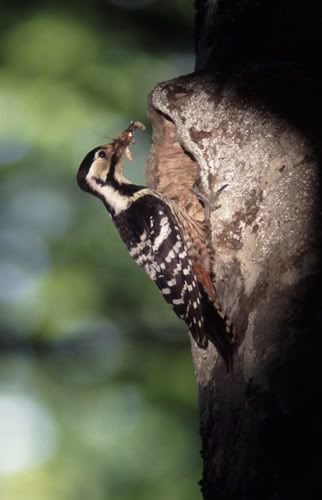
Measurements: Length 24-26 cm. Wingspan 38-40 cm, hence the largest Dendrocopos woodpecker in Europe, some 2-3 cm longer than Great Spotted and Syrian Woodpeckers. White-backed is not a difficult woodpecker to identify once found, usually immediately appearing to be rather long-necked and long-billed. The nominate leucotos race is described here (lilfordi in another post). Birds do indeed have a white upper-rump and lower-back but they are not as “white-backed" as their name suggests. The upper back is glossy black and the white on the back below this is sometimes obscured and difficult to see. Rather, it is the white barred coverts, particularly the upper broad white bar of the median coverts that are seen. When a bird takes flight the large white area composed of the lower scapulars, lower back and upper rump comes into view. In most cases this white area is crescent-shaped and connects with the uppermost wing bars. However, on some birds this white area is only slightly broader than the white upper-wing bars. The amount of white on the lower back also varies. There can also be significant variation between birds in the shape and extent of their white back. Individual plumage variations can sometimes exist between populations and sometimes within them. The wings are black but dotted with white on the greater coverts. The flight feathers are crossed by rows of large white spots that almost form bars. White bars on the upper-wing, are often obscured by the white back patch, which sometimes forms a broad fringe across the back. The broad white bar on the upper-wing is striking when in flight and on perching birds seen from side. On a rear view heavy white barring can be seen to extend across the closed tertials (unlike Great Spotted and Syrian). The scapulars are glossy black. The upper-tail coverts and most of the rectrices are black. The outer rectrices are white with thin black barring. The ventral region and under-tail coverts are pink, never red, and not strongly demarcated from the whitish belly (as Great Spotted). The pink extends up and merges into the lower belly and sometimes colours the flanks and leg feathering (as Middle Spotted). Under-parts are white or cream, but often with a yellowish hue. Long black streaks cover the flanks, and sides of the breast and belly (as Middle Spotted). Despite having pink and yellow areas on the under-parts, White-backed Woodpecker always shows much white in flight. The face pattern can vary slightly from bird to bird but typically the black malar stripe starts from the lower mandible (unlike Middle Spotted) and meets the post-auricular stripe on the side of the neck to form a black T-junction. From here a black stripe runs down to the sides of the neck and onto the upper breast, and below this the black flank streaking is strongest. The post-auricular stripe runs over and across the ear-coverts towards the nape, but not touching it (like Syrian and Middle Spotted but unlike Great Spotted). Face, chin and throat are all white but buff behind the eye. On a rear view a black linking stripe from black nape down to glossy black mantle can be seen (recalling Middle Spotted). The forehead and lores are greyish. The bill is grey, long and very thin at the tip, the iris reddish brown and the legs and toes grey. The photo here is of an adult male leucotos race, taken in the Bükk Hills, Hungary (László Nehézy).
Showing posts sorted by relevance for query white-backed woodpecker. Sort by date Show all posts
Showing posts sorted by relevance for query white-backed woodpecker. Sort by date Show all posts
Friday, 14 September 2007
White-backed Woodpecker: general ID
Measurements: Length 24-26 cm. Wingspan 38-40 cm, hence the largest Dendrocopos woodpecker in Europe, some 2-3 cm longer than Great Spotted and Syrian Woodpeckers. White-backed is not a difficult woodpecker to identify once found, usually immediately appearing to be rather long-necked and long-billed. The nominate leucotos race is described here (lilfordi in another post). Birds do indeed have a white upper-rump and lower-back but they are not as “white-backed" as their name suggests. The upper back is glossy black and the white on the back below this is sometimes obscured and difficult to see. Rather, it is the white barred coverts, particularly the upper broad white bar of the median coverts that are seen. When a bird takes flight the large white area composed of the lower scapulars, lower back and upper rump comes into view. In most cases this white area is crescent-shaped and connects with the uppermost wing bars. However, on some birds this white area is only slightly broader than the white upper-wing bars. The amount of white on the lower back also varies. There can also be significant variation between birds in the shape and extent of their white back. Individual plumage variations can sometimes exist between populations and sometimes within them. The wings are black but dotted with white on the greater coverts. The flight feathers are crossed by rows of large white spots that almost form bars. White bars on the upper-wing, are often obscured by the white back patch, which sometimes forms a broad fringe across the back. The broad white bar on the upper-wing is striking when in flight and on perching birds seen from side. On a rear view heavy white barring can be seen to extend across the closed tertials (unlike Great Spotted and Syrian). The scapulars are glossy black. The upper-tail coverts and most of the rectrices are black. The outer rectrices are white with thin black barring. The ventral region and under-tail coverts are pink, never red, and not strongly demarcated from the whitish belly (as Great Spotted). The pink extends up and merges into the lower belly and sometimes colours the flanks and leg feathering (as Middle Spotted). Under-parts are white or cream, but often with a yellowish hue. Long black streaks cover the flanks, and sides of the breast and belly (as Middle Spotted). Despite having pink and yellow areas on the under-parts, White-backed Woodpecker always shows much white in flight. The face pattern can vary slightly from bird to bird but typically the black malar stripe starts from the lower mandible (unlike Middle Spotted) and meets the post-auricular stripe on the side of the neck to form a black T-junction. From here a black stripe runs down to the sides of the neck and onto the upper breast, and below this the black flank streaking is strongest. The post-auricular stripe runs over and across the ear-coverts towards the nape, but not touching it (like Syrian and Middle Spotted but unlike Great Spotted). Face, chin and throat are all white but buff behind the eye. On a rear view a black linking stripe from black nape down to glossy black mantle can be seen (recalling Middle Spotted). The forehead and lores are greyish. The bill is grey, long and very thin at the tip, the iris reddish brown and the legs and toes grey. The photo here is of an adult male leucotos race, taken in the Bükk Hills, Hungary (László Nehézy).

Wednesday, 5 September 2007
White-backed Woodpecker: distribution and range
The global range of White-backed Woodpecker lies within the Palearctic from Fenno-Scandia and central Europe eastwards through boreal Asia, to Kamchatka, China, the Korean Peninsula and Japan. Though generally regarded as an “eastern" species White-backed Woodpeckers probably inhabited all of Europe including Britain in the past, possibly up to the Middle Ages, when there was still much old forest covering the landscape. Today it is Europe’s rarest woodpecker, being often very local in the boreal and temperate zones of central and Eastern Europe, Fenno-Scandia and Russia. Elsewhere it has a rather scattered distribution with small relic populations of the lilfordi race in the Pyrenees, the Balkans and the Apennines. Italy is home to some isolated populations of the lilfordi race (leucotos is accidental and very rare in the north of the country with a few records from Liguria, Lombardia and Trentino). The two known populations of lilfordi are in central and southern Italy respectively. The most important is in the Abruzzo Mountains in the Apennines in old beech forests, and has been known since 1929 and confirmed in 1959. The Abruzzo National Park, Majella National Park, Monti della Laga National Park and Terminillo Mountains all hold small numbers. Over most of its range White-backed Woodpecker is uncommon, if not rare, though in some areas such as the Carpathians and the lowland forests of Belarus it is widely distributed. A major contraction in range, particularly in the west of Europe, occurred in the 19th and 20th centuries. Yet despite its overall rarity in Europe the species can be locally the most common woodpecker. For example, in the old mixed forests of the Austrian Chalk Alps White-backed Woodpecker is more common than Great Spotted.
Wednesday, 19 September 2007
Lesser Spotted Woodpecker: general ID
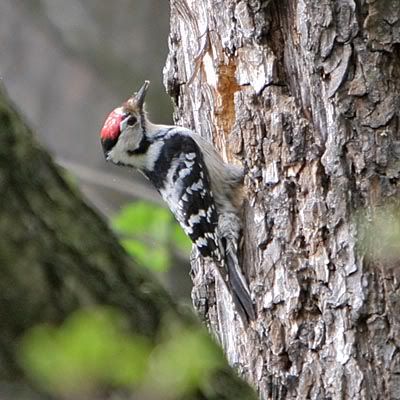 Measurements: Length 14-16 cm. Wingspan 24-27 cm. Europe’s smallest woodpecker is just two-thirds the size of Great Spotted and Syrian Woodpeckers and around three-quarters the size of Middle Spotted Woodpecker. This species appears short-tailed and round headed in shape. It is the only European Dendrocopos woodpecker to lack red or pink colouration on the under-tail coverts and ventral area, which are white, spotted with grey-black. It is also "ladder-backed", lacking the white oval scapular patches of most other Dendrocopos woodpeckers. In fact, in terms of the black-and-white back pattern, Lesser Spotted most resembles White-backed Woodpecker. Black lower mantle, scapulars and upper rump barred white. Breast and belly whitish, with a suggestion of buff. White flanks and sides of breast generally finely streaked with black, but never to the extent of Middle Spotted Woodpecker. The black tips of the greater and some median wing-coverts are spotted white. Black flight feathers barred boldly white. Upper tail black, outer rectrices white with 2-3 black bars before tips. Sides of face, ear-coverts, chin and throat white. Black malar stripe runs from base of lower mandible to side of neck where it joins black lateral neck stripe and post-auricular stripe. A large black area is formed at this T-junction. The lateral neck stripe runs down onto the side of the breast. On the vast majority of birds the post-auricular stripe reaches only halfway or so across the ear-coverts and does not touch the black nape (this varies with race). Thus the reddish-brown eye (iris) is set in a large, open area of white. The bill is mostly grey-charcoal, with the base of the lower mandible paler, often lead coloured. It appears slight, pointed and rather weak. However, 12-18 mm long, it is in fact relatively large for the overall size of the bird. The legs are greyish-green. The photo shows an adult male at Chemnitz, Germany (Thomas Kraft).
Thursday, 17 January 2008
Further reading
Here is a selection of articles on woodpeckers that I have published in the popular birding magazines in Europe:
In English:
Identifying the presence of woodpecker (Picidae) species on the basis of their holes and signs. Aquila, Vol. 102. (1995).
Black Woodpecker in Europe - Britain next? Birding World Vol. 11. 10 (1998).
The Rot Sets In (White-backed Woodpecker) Birdwatch, Issue 77, Nov 1998.
Pecking Order (Finding Woodpeckers). Birdwatch, Issue 81, March 1999.
The Identification of Syrian Woodpecker. Alula, Vol. 5, 3/1999.
Three-toed Woodpecker - species, races, clines. Birding World, Vol. 17. 5. May 2004.
Drum major (White-backed Woodpecker ID). Birdwatch, Issue 145, July 2004.
In Finnish:
Syyriantikan maarrittaminen. Alula, Vol. 5, 3/1999.
In Swedish:
Balkanspetten sprider sig norrut i Europa. Var Fagelvarld, 5/1997.
In Hungarian:
Atipikus farokmintázatú nagy fakopáncs. (Great Spotted Woodpecker with atypical tail colouration). Túzok, Vol. 2. No. 4 (1997).
Harkalyok nyomaban. Madartavlat, Vol. 5, No. 1. 1998.
Balkáni fakopáncs (Dendropcopos syriacus) műhelyei. (Syrian Woodpecker Anvils) Túzok, Vol. 4. No. 4 (1999).
In French:
Identification du Pic syriaque (Dendrocopos syriacus) et repartition en Europe. Ornithos, Vol. 3. No. 4 (1996).
In English:
Identifying the presence of woodpecker (Picidae) species on the basis of their holes and signs. Aquila, Vol. 102. (1995).
Black Woodpecker in Europe - Britain next? Birding World Vol. 11. 10 (1998).
The Rot Sets In (White-backed Woodpecker) Birdwatch, Issue 77, Nov 1998.
Pecking Order (Finding Woodpeckers). Birdwatch, Issue 81, March 1999.
The Identification of Syrian Woodpecker. Alula, Vol. 5, 3/1999.
Three-toed Woodpecker - species, races, clines. Birding World, Vol. 17. 5. May 2004.
Drum major (White-backed Woodpecker ID). Birdwatch, Issue 145, July 2004.
In Finnish:
Syyriantikan maarrittaminen. Alula, Vol. 5, 3/1999.
In Swedish:
Balkanspetten sprider sig norrut i Europa. Var Fagelvarld, 5/1997.
In Hungarian:
Atipikus farokmintázatú nagy fakopáncs. (Great Spotted Woodpecker with atypical tail colouration). Túzok, Vol. 2. No. 4 (1997).
Harkalyok nyomaban. Madartavlat, Vol. 5, No. 1. 1998.
Balkáni fakopáncs (Dendropcopos syriacus) műhelyei. (Syrian Woodpecker Anvils) Túzok, Vol. 4. No. 4 (1999).
In French:
Identification du Pic syriaque (Dendrocopos syriacus) et repartition en Europe. Ornithos, Vol. 3. No. 4 (1996).
Sunday, 22 March 2015
Tree stump shaved by White-backed Woodpecker

Tuesday, 11 September 2007
Great Spotted Woodpecker: general ID
 Measurements: Length 21-23 cm. Wingspan 34-39 cm. Taking all European species into account Great Spotted is a medium sized woodpecker. It is the same size, shape and structure as Syrian Woodpecker and thus between the larger White-backed and smaller Middle Spotted Woodpecker. The nominate race major is described here. This is the woodpecker with which most Europeans are familiar. It is a typical Dendrocopos species, essentially black and white, one of the so-called “pied" woodpeckers. The upper-parts from mantle to rump are essentially glossy black and marked with white. The inner scapulars are black, outer scapulars and inner greater and median coverts white and combine to produce large white ovals on the “shoulders". These white oval patches show particularly well in flight. The chin and throat are white or cream. The breast, belly and flanks are also white, sometimes slightly buff, and generally lack streaking. In Europe any grey or rusty tones are usually a result of contact with trees. The under-tail coverts and ventral area are scarlet and there is often a sharp demarcation between this area and the white lower belly: the red does not gradually fade or merge with the white it does on some other species. A long, black malar stripe runs from the bill across the cheek to the side of the neck, where it joins the post-auricular stripe and a lateral stripe running from the upper breast sides and a short joining stripe from the mantle and shoulder. These black lines meet below the ear-coverts. The post-auricular stripe continues across the face below the ear-coverts and reaches the nape. Thus, an enclosed white area is formed on the side of the face. No other European Dendrocopos woodpecker has this enclosed white face patch feature, as the post-auricular stripes on other species do not reach the nape. The forehead and lores are white and the nasal tufts black. The crown is glossy black. A black linking line runs from the nape down the hind-neck to the mantle. This stripe is joined at on each side by black post-auricular stripe thus birds seen from rear show a black "cross" on hind-neck. The upper-tail is matt black and under-tail a dull black-brown. The outer-most rectrix (T6) is black but hidden under the tail-covets. The adjacent two rectrices are white and maybe barred with black (in Syrian it is the reverse, the rectrices are mainly black and dotted with white). There is often some white on the third rectrix but all other tail feathers are plain black. The upper-wing is matt black and the wing-coverts glossy black. The under-wing coverts are smoky white with some black spots, wing feathers grey-black and heavily barred with white-buff. The flight feathers are black and dotted with rows of 5 or 6 white spots that almost form bars. The stocky, dagger-shaped bill is broad at the base and can comprise 60% of the skull length. It is grey to charcoal in colour with the base of the lower mandible paler. The eyes are usually dark red and the legs grey-olive. The photo here is of an adult male, taken in the UK (Bill Baston).
Monday, 24 September 2007
Holes: White-backed Woodpecker
 This photo shows an adult male White-backed Woodpecker (lilfordi race) in the Abruzzo mountains, central Italy (Paul Harris). Note the almost perfectly round cavity entrance, which is typical for many species including White-backed. The paleness of the exposed wood in the entrance hole indicates the "newness" of the cavity. Indeed, woodpeckers excavate fresh, new nesting holes every spring, though occasionally an old hole will be re-used, presumably after it has proven to be a success, safe nest site. Used cavities often remain clean, as woodpeckers are hygenic breeders removing the droppings of their chicks as they grow, and thus can be re-used (by the woodpeckers who made it or by secondary cavity breeders). White-backed Woodpeckers rarely re-use a hole. This is probably because their holes often do not survive from one spring to the next as they are invariably made in very rotten trees which decay rapidly and become unstable.
Holes: White-backed Woodpecker - natural hole use
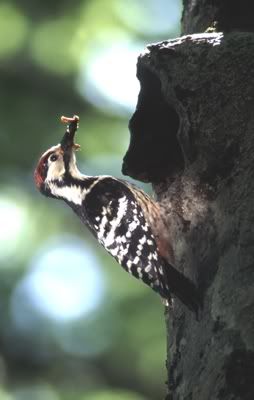 This important photo shows an adult male White-backed Woodpecker (lilfordi race) in the Abruzzo mountains, central Italy (Paul Harris). This is a very interesting shot indeed as it captures the bird using a natural tree hole as a nesting site. It is very rare for a European woodpecker (except Wryneck) to nest in a tree-hole which it did not create itself. Though the entrance is "natural" it is thought that this White-backed pair pair adapted and enlarged the cavity to suit their needs. This breeding site was also successful, note the male has food items in his beak which he is about to offer to the chicks inside the cavity.
Wednesday, 5 September 2007
Woodpeckers: Name and Genus
Wryneck Jynx torquilla. Other English names are Northern Wryneck and Eurasian Wryneck. Genus: Jynx, Linnaeus 1758. First described by Linnaeus in 1758.
Grey-headed Woodpecker Picus canus. Other English names are Grey-faced Woodpecker and Grey-headed Green Woodpecker. Genus: Picus, Linnaeus 1758. First described by Gmelin in 1788.
Green Woodpecker Picus viridis. Other English names are European Green Woodpecker and Eurasian Green Woodpecker. Genus: Picus, Linnaeus 1758. First described by Linnaeus in 1758.
Black Woodpecker Dryocopus martius. Other English names are Great Black Woodpecker. Genus: Dryocopus, Boie 1826. First described as Picus martius by Linnaeus in 1758.
Great Spotted Woodpecker Dendrocopos major. Genus: Dendrocopos, Koch 1816. No other English names. First described as Picus major by Linnaeus in 1758.
Syrian Woodpecker Dendrocopos syriacus. Genus: Dendrocopos, Koch 1826. No other English names. First described as Picus syriacus by Hemprich & Ehrenberg, 1833.
Middle Spotted Woodpecker Dendrocopos medius. No other English names. Genus: Dendrocopos, Koch 1816. First described as Picus medius by Linnaeus in 1758.
White-backed Woodpecker Dendrocopos leucotos. Another English name used is Lilford’s Woodpecker (for lilfordi race when treated as a full species). Genus: Dendrocopos, Koch 1816. First described as Picus leucotos by Bechstein in 1803.
Lesser Spotted Woodpecker Dendrocopos minor. No other English name. Genus: Dendrocopos, Koch 1816. First described as Picus minor by Linnaeus in 1758.
Three-toed Woodpecker Picoides tridactylus. Another English name used is Eurasian Three-toed Woodpecker. Genus: Picoides, Lacépéde 1799. First described as Picus tridactylus by Linnaeus in 1758.
Grey-headed Woodpecker Picus canus. Other English names are Grey-faced Woodpecker and Grey-headed Green Woodpecker. Genus: Picus, Linnaeus 1758. First described by Gmelin in 1788.
Green Woodpecker Picus viridis. Other English names are European Green Woodpecker and Eurasian Green Woodpecker. Genus: Picus, Linnaeus 1758. First described by Linnaeus in 1758.
Black Woodpecker Dryocopus martius. Other English names are Great Black Woodpecker. Genus: Dryocopus, Boie 1826. First described as Picus martius by Linnaeus in 1758.
Great Spotted Woodpecker Dendrocopos major. Genus: Dendrocopos, Koch 1816. No other English names. First described as Picus major by Linnaeus in 1758.
Syrian Woodpecker Dendrocopos syriacus. Genus: Dendrocopos, Koch 1826. No other English names. First described as Picus syriacus by Hemprich & Ehrenberg, 1833.
Middle Spotted Woodpecker Dendrocopos medius. No other English names. Genus: Dendrocopos, Koch 1816. First described as Picus medius by Linnaeus in 1758.
White-backed Woodpecker Dendrocopos leucotos. Another English name used is Lilford’s Woodpecker (for lilfordi race when treated as a full species). Genus: Dendrocopos, Koch 1816. First described as Picus leucotos by Bechstein in 1803.
Lesser Spotted Woodpecker Dendrocopos minor. No other English name. Genus: Dendrocopos, Koch 1816. First described as Picus minor by Linnaeus in 1758.
Three-toed Woodpecker Picoides tridactylus. Another English name used is Eurasian Three-toed Woodpecker. Genus: Picoides, Lacépéde 1799. First described as Picus tridactylus by Linnaeus in 1758.
Friday, 14 September 2007
White-backed Woodpecker: lilfordi race general ID
The general features described elsewhere in this blog for nominate leucotos apply equally to the southern European race lilfordi. However, there are some striking and important differences in plumage that together with wing and bill measurements, voice, habitat selection and distribution, have resulted in this race sometimes being considered a separate species i.e. Lilford’s Woodpecker. Lilfordi is slightly larger, overall darker and more heavily streaked with long, black, flecks on the flanks, breast and belly. In addition to vertical streaks there are also some horizontal bars on the flanks that nominate lacks. The pink ventral area extends further up onto the belly than leucotos, often onto the lower breast. Under-parts various shades of white, cream, often dusky or tinged buff and always more marked and darker than leucotos. The forehead, lores, cheeks and throat are also more yellow. The black post-auricular stripe and malar stripe are broader and, where they join to form a T-junction, below the ear-coverts, a larger black area is formed. Face patterns may vary slightly from bird to bird but on all the post-auricular stripe runs over the ear-coverts and finishes much closer to, or even touches, the nape. On leucotos it never touches the nape and a wider white gap is clear. Wings have narrower white bars than on nominate. But above all lilfordi lacks the clear white lower-back and upper rump patch of leucotos race. Lilfordi is thus less "white-backed" than leucotos. It is rather "barred-backed" or perhaps "ladder-backed" due to the white-back and upper-rump being vermiculated with black. The rump of this race often seems totally black.
Friday, 4 January 2008
Woodpeckers in Europe: status, abundance
Globally, many woodpecker species are threatened or endangered. This is also the case for some species in certain parts of Europe. This situation is largely due to the degradation, fragmentation and loss of the wooded habitats in which these birds live. The conservation of Europe’s woodpeckers is inextricably linked to the conservation of wooded habitats. Woodpeckers are good indicators of forest quality. They are indicators of forest bio-diversity, as they are often rather demanding in terms of their ecological needs. Innumerable other woodland and forest species depend upon the same ecological requirements as woodpeckers for their existence and survival. Thus, besides being worthy of protection and conservation for their own sakes, woodpeckers are highly suitable candidates for so-called “umbrella species”. That is, the study and conservation of woodpeckers and their habitats directly relates to, and invariably results in, the study of many other species of plant and animal.The study of a demanding species, family or guild defines the basic requirements for forest habitats and landscapes. However, each woodpecker species uses a given forest differently and this fact is of great use to those studying woodpeckers and to conservationists in general. Subtle changes in a forest ecosystem can be detected via the responses and trends of woodpeckers. Each woodpecker species can be regarded as an umbrella species for all those inconspicuous, and often threatened, invertebrates that inhabit the same forests. In Finland and Sweden, for example, efforts to conserve White-backed Woodpeckers habitat also means that threatened and rare beetle species are also helped as they share the same old-growth habitat. Saving the White-backed Woodpecker means saving it’s habitat and hence all the diverse species that share it. Three-toed Woodpecker, too, is a species that can act as an indicator of the presence of rare spruce bark beetles, or in other words, of the condition of old-growth boreal forest.The conservation status of Europe’s woodpeckers varies across the continent. Species which are endangered in one area, may be common elsewhere. A range of factors, both natural and unnatural, have made this so. However, in many parts of Europe the factors which determine whether certain woodpeckers occur or not, and whether they are common or not, are most certainly not natural. In a nutshell, human influence has shaped much of Europe’s wooded landscape and this influence has almost always been detrimental. As a general rule it can be taken that there are fewer woodpeckers in highly developed countries than there are in less-developed countries. In highly developed European countries greater rates of urbanisation have resulted in an overall picture composed of landscapes of inferior quality and ultimately there is less suitable woodpecker habitat. Of course, there are exceptions but the relative abundance of woodpeckers in Eastern Europe (in terms of both species and actual populations) and the relative paucity of woodpeckers in Western Europe (again, in terms of both species and actual populations) bears this out. There is no doubt that forest biodiversity in Europe has been negatively affected by the economic advances and urban developments of the last 100 years or so.
Thursday, 13 September 2007
Woodpecker signs: wood-chips
 Woodpeckers produce wood-chips when they excavate holes or bore into timber for prey. Wood-chips are left where they fall and often accumulate below work sites. It is usually easier to distinguish wood-chips that are the result of nest-hole excavation and attribute them to species, than it is those that have resulted from foraging. The size of wood-chips is a major clue. Those that are 10cm or more are inevitably the work of Black Woodpecker. But when Green Woodpecker excavates soft wood trees such as willows, aspen and fruit trees, the wood-chips which litter the ground below can also be quite large, sometimes 7-8cm, but never as large as those of Black Woodpecker. The size of wood-chips also depends upon the structure of the wood, that is, whether it long-grained or short-grained and whether the fibres are tough or not. The quality of the wood-chips is important. It should be remembered that only Black and Great Spotted Woodpeckers regularly work on healthy, sound wood and thus clean, solid wood-chips with no signs of decay or fungi are usually the result of work done by these two species. All other European woodpeckers tend to excavate, or forage upon, soft or rotten wood, usually affected by fungi. Piles of wood dust at the base of dead stumps may indicate White-backed Woodpeckers, which often completely pulverise timber (see photo) that contains beetle larvae. This photo shows a typical feeding site of White-backed Woodpecker. A finely shaved rotting stump, from top to ground level and with wood-chips but also powder-like debris. Bükk Hills, Hungary (Szabolcs Kókay)
Friday, 14 September 2007
Middle Spotted Woodpecker: general ID
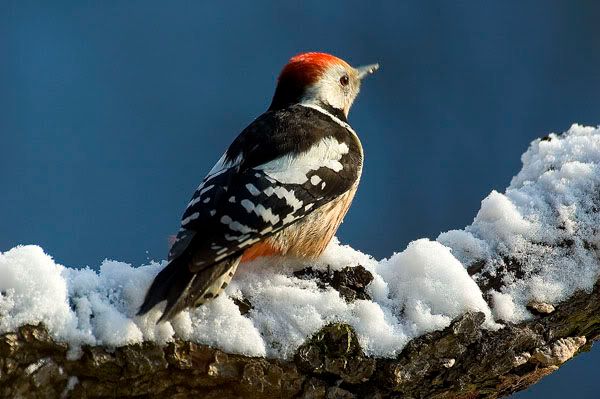 Measurements: Length 20-22 cm. Wingspan 33-34 cm. Despite its vernacular and scientific names Middle Spotted Woodpecker is not mid-way in size between its Dendrocopos relatives, the smaller Lesser Spotted and larger Great Spotted and Syrian. Middle Spotted is much closer to the two larger species in all measurements, being just 15% smaller, but is around 40% larger than Lesser Spotted. Middle Spotted differs from all its European relatives in being almost totally monomorphic, i.e. males and females are almost identical in appearance. Differences between the sexes will be dealt with in other posts in this blog. Both adults are essentially black and white although the white areas are rather dusky. Middle Spotted Woodpecker has less black on the face than other Dendrocopos species. Indeed, the cheeks, ear-coverts, forehead, chin, throat, neck and upper breast are all shades of off-white with a cream, buff or grey tinge. Lores and nasal tufts grey. There is only the suggestion of a malar stripe and on some birds it may be lacking altogether. Even when a malar is present it never starts from the lower mandible, but rather begins a little way short. In this respect it differs from all other European Dendrocopos species. The ear-coverts are creamy white, often rather dusky, and are crossed only partially by a black post-auricular stripe. The extent that the post-auricular stripe crosses the ear-coverts varies, but it never meets the black nape. However, on some views, particularly when birds are twisting their head during foraging, it may seem that the post-auricular stripe touches the nape. The iris is dark red, but usually appears black, and stands out as a dark bead in the otherwise pale face. An isolated black crescent-shaped area is formed below the cheek on the side of the neck where the base of the post-auricular stripe, whatever malar stripe there is and the shoulder stripe meet. The shoulder stripe runs by the side of the throat down to the upper sides of the breast where it merges into black streaks on the upper flank. The thin black line down back of neck linking the crown to the mantle recalls Syrian rather than Great Spotted as there are no post-auricular stripes joining it at the sides. The dark eye is clearly isolated in the white side of the face. Both adults have a red crown bordered by the white of the face. The lower breast, belly and flanks are essentially creamy white though this varies from dirty white to buff and there are often distinct yellowish tones on the flanks, belly and sometimes the breast. This yellowish wash may reach the leg feathering on some birds. The extent and strength of yellow is very variable. The lower belly, under-tail coverts and ventral area are flushed with pink. This pink spreads higher up the under-body than similar colouration does on other pied woodpeckers. It is also always paler than the red of the crown (recalling Syrian rather than Great Spotted). The flanks are heavily streaked with long black lines (recalling White-backed). The mantle, inner scapulars, back, rump and upper tail coverts are matt black. The outer scapulars are creamy white and form ovals, similar to but smaller than, those of Syrian and Great Spotted. The primaries and secondaries are black, heavily dotted and barred with white. Some of the rows of white spots on the flight feathers almost join to form bars. The upper wing-coverts are black and the inner median wing-coverts white with black bases. The greater coverts are black with white tips. The axillaries are dusky or dirty white. Most of the tail is black though the outer two rectrices are white dotted with 2 or 3 black bars (recalling Great Spotted rather than Syrian) whilst the third rectrix is sometimes edged white. The bill is visibly small and weak, mostly grey but with the lower mandible paler. The legs are grey. Males and females overlap in all measurements and features, but all size differences are rather subtle and slight and probably more related to feeding and foraging behaviour than to visual recognition. This photo of an adult male, showing most of the classic ID features, was taken in northern Hungary (László Nehézy).
Wednesday, 27 February 2008
White-backed Woodpecker: winter feeding site
 In winter woodpecker feeding sites are often easier to locate than in other seasons. Not in the least because of the lack of foliage on trees, but also because wood chips and other debris is easier to spot on snow-covered ground. This photo shows a typical winter feeding site of White backed Woodpecker Dendrocopos leucotos. A thin, rotting tree has been worked extensively to expose the wintering quarters of wood-boring beetles and other invertebrates. The tree is worked carefully and systematically for days, being shaving and chiselled rather than bored deeply into or hacked apart. The rucksack at the base of the tree gives an indication of how slim the tree is. This photo was taken by Romuald Mikusek in the Biebrza National Park, north-east Poland.
Wednesday, 5 September 2007
Europe's 10 woodpecker species
Europe's ten Picidae species are:
Wryneck Jynx torquilla
Grey-headed Woodpecker Picus canus
Green Woodpecker Picus viridis
Black Woodpecker Dryocopus martius
Great Spotted Woodpecker Dendrocopos major
Syrian Woodpecker Dendrocopos syriacus
Middle Spotted Woodpecker Dendrocopos medius
White-backed Woodpecker Dendrocopos leucotos
Lesser Spotted Woodpecker Dendrocopos minor
Three-toed Woodpecker Picoides tridactylus
Wryneck Jynx torquilla
Grey-headed Woodpecker Picus canus
Green Woodpecker Picus viridis
Black Woodpecker Dryocopus martius
Great Spotted Woodpecker Dendrocopos major
Syrian Woodpecker Dendrocopos syriacus
Middle Spotted Woodpecker Dendrocopos medius
White-backed Woodpecker Dendrocopos leucotos
Lesser Spotted Woodpecker Dendrocopos minor
Three-toed Woodpecker Picoides tridactylus
Wednesday, 23 October 2013
White-backed Woodpecker male

Monday, 17 November 2014
Gallery: White-backed Woodpecker male

Tuesday, 28 June 2011
Gallery: White-backed Woodpecker male

Friday, 20 May 2016
White-backed Woodpecker male

Friday, 28 November 2008
Gallery: White-backed Woodpecker adult male lilfordi race
 Adult male White-backed Woodpecker lilfordi race. Photo taken by Paul Harris in the Abruzzo Mountains, Italy.
Subscribe to:
Posts (Atom)