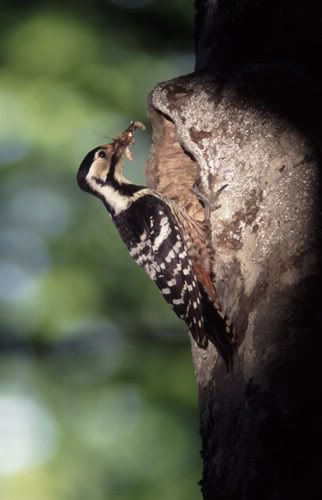
Adult male lilfordi has a red crown edged with black and (as with the nominate race) is slightly larger and longer billed than the female. This photo shows an adult male lilfordi at a nest-hole in the Abruzzi mountains, central Italy (Paul Harris).
Friday, 14 September 2007
White-backed Woodpecker: male lilfordi race ID
Adult male lilfordi has a red crown edged with black and (as with the nominate race) is slightly larger and longer billed than the female. This photo shows an adult male lilfordi at a nest-hole in the Abruzzi mountains, central Italy (Paul Harris).

White-backed Woodpecker: lilfordi race general ID
The general features described elsewhere in this blog for nominate leucotos apply equally to the southern European race lilfordi. However, there are some striking and important differences in plumage that together with wing and bill measurements, voice, habitat selection and distribution, have resulted in this race sometimes being considered a separate species i.e. Lilford’s Woodpecker. Lilfordi is slightly larger, overall darker and more heavily streaked with long, black, flecks on the flanks, breast and belly. In addition to vertical streaks there are also some horizontal bars on the flanks that nominate lacks. The pink ventral area extends further up onto the belly than leucotos, often onto the lower breast. Under-parts various shades of white, cream, often dusky or tinged buff and always more marked and darker than leucotos. The forehead, lores, cheeks and throat are also more yellow. The black post-auricular stripe and malar stripe are broader and, where they join to form a T-junction, below the ear-coverts, a larger black area is formed. Face patterns may vary slightly from bird to bird but on all the post-auricular stripe runs over the ear-coverts and finishes much closer to, or even touches, the nape. On leucotos it never touches the nape and a wider white gap is clear. Wings have narrower white bars than on nominate. But above all lilfordi lacks the clear white lower-back and upper rump patch of leucotos race. Lilfordi is thus less "white-backed" than leucotos. It is rather "barred-backed" or perhaps "ladder-backed" due to the white-back and upper-rump being vermiculated with black. The rump of this race often seems totally black.
White-backed Woodpecker: juvenile female ID
Juvenile female White-backeds have red colouration only on the fore-crown (adult female has none) but this often rather patchy, and always less than on juvenile male. Sometimes this patch is merely a few red or pink feathers. The true extent of red on the crown becomes evident some twelve days after hatching.
White-backed Woodpecker: juvenile male ID
Juvenile male White-backeds have an all red crown which extends at the back of the head to the black nape and sideways to the white cheeks. This becomes apparent around twelve days after hatching and is more pronounced as birds peep out of the hole prior to fledging. Male fledglings are generally heavier, and have longer bills and tarsi than sibling females though these factors only noticeable in the hand.
White-backed Woodpecker: juvenile ID
 Juvenile White-backed Woodpeckers are sexually dimorphic whilst still in the nest. It takes around seven months (i.e. into the winter following fledging) for juveniles to attain full adult plumage. Juveniles are duller and browner than adults and black areas matt rather than glossy. White areas are greyer, dirtier than on adult and there is often a grey smudge over the ear-coverts and behind eye (similar to that on juvenile Syrian Woodpecker). The pink ventral region is smaller and paler than on adults and the dark streaks on the under-body are more diffuse. Both male and female juveniles have red on the crown (see other posts) but they are not as strong in colour as on adult males. The red crown is sometimes rather rusty and with grey or black flecks. Bare parts are grey. The photo here shows a fledging female at Varmland, Sweden, taken in May 1994 (Göran Ekström). Note that there is only a hint of pink on the forecrown on this bird.
White-backed Woodpecker: adult female ID
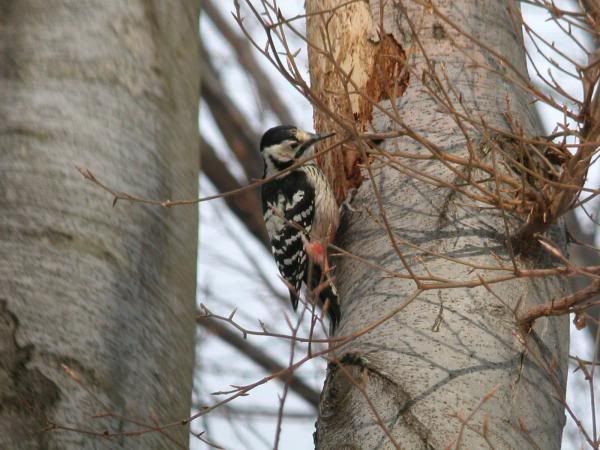 Adult female White-backed Woodpeckers lack the red crown of males. The complete crown from forehead to nape is black. Overall females are slightly smaller than males and their bill is slightly shorter, but these features are not really noticeable in the field. This photo of an adult female leucotos was taken in the Bakony Hills, Hungary (Gábor Vasuta).
White-backed Woodpecker: adult male ID
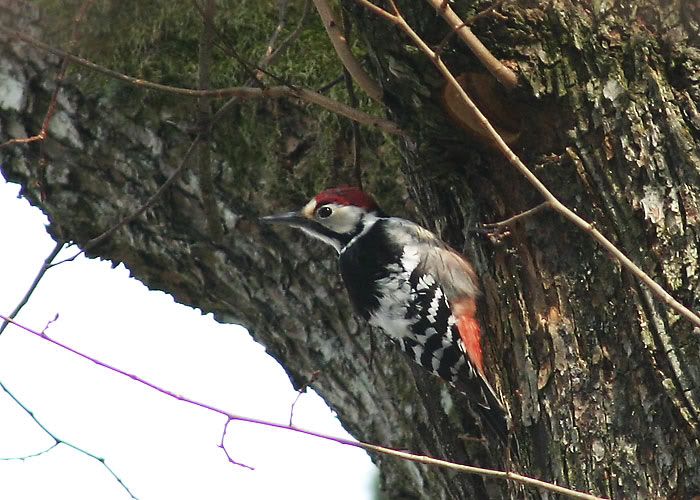 As is the case (though to varying degrees) with other "pied" woodpeckers in Europe, White-backed males are slightly heavier, bigger and have longer bills than females. Bill length is the most significant morphological feature in terms of sexual dimorphism, but is not rarely noticeable in the field and only when a pair is seen together. The all red crown is the main feature distinguishing males from females (which lack red on the head). Sometimes these red feathers have visible dark bases. On some males the pink of the under-tail coverts and vental area reaches as far as the lower belly, lower flanks and leg feathering. On females it is usually less extensive, though this is variable. The photo here is of an adult male leucotos in Estonia, taken on 2.4.2005 (Uku Paal).
Subscribe to:
Posts (Atom)