
 Measurements: Length 22-23 cm. Wingspan 34-39 cm. Seems slimmer but not shorter in length, than Great Spotted, but in reality ison average the same size. From the rear the head and neck seem slimmer and longer due to the single vertical black stripe which runs downwards from the crown to the mantle. Syrian Woodpecker is a typical "pied" Dendrocopos woodpecker with mostly black upper-parts, mostly pale under-parts, a black and white head, black wings barred with white, large white oval scapular patches and a pink vent and under-tail coverts. Until recently the widely-used field guides tended to emphasize the lack of a black line (post-auricular stripe) across the ear-coverts as being the main feature separating Syrian from Great Spotted Woodpecker. This despite the fact that many papers on the species, some published decades ago, have emphasized the importance of other features, particularly tail pattern. The face pattern of Syrian Woodpecker is important, but it should not be regarded as the main difference (see below). Overall the black plumage (particularly crown, mantle and back) is matt rather than glossy. The under-side, and upper-side, of the outer rectrices are black with light white bars, unlike Great Spotted where the dark under-tail is always boldly barred white. This is a good feature to look for on flying birds, as this lack of white can be remarkably easy to see, certainly often easier than the face pattern. When seen from behind (e.g. when birds are climbing at a hole entrance) Syrian shows only a vertical black stripe which runs from the crown down the hind-neck to the mantle (in males this line runs from the red nape patch). It does not show the "black-cross" that Great Spotted has at the back of the head which is created by the two post-auricular stripes (one on each side of the face) touching the hind-crown, and thus the sides of the face appear very white. In atypical birds (where there is a hint of an extension from the malar stripe) or in birds moving or holding their heads askew (e.g. when foraging) it may sometimes seem that the nape is reached. The vent and under-tail coverts are pink. Though variable in shade from bird to bird, on some being almost red, this area is never scarlet as in a typical Great Spotted. The pink area also often reaches up onto the lower belly. "Syrians" which show scarlet here should be scrutinized for other plumage features as they may prove to be hybrids, but beware of individual variation. A black malar stripe leads from the lower mandible and meets the lateral neck stripe below the ear-coverts. Though in some birds it may curl up towards the ear-coverts, where it meets the lateral neck stripe, it never crosses the ear-coverts to form a post-auricular stripe. A lateral neck stripe extends from the malar stripe (which it joins below the ear-coverts) across the neck sides to the shoulder and upper breast. It rarely reaches the scapulars, whereas in adult Great Spotted it almost always does via a short connecting bar. Together with the malar stripe it forms a black crescent around the throat, recalling Middle Spotted Woodpecker. These facial features combine to create a more open, whiter appearance than Great Spotted. The white of the face extends in an unbroken sweep from the lores, around the eye (there is also usually more white above the eye than in Great Spotted) across the ear coverts, to the sides and rear of the neck and down to the breast. White spots on the black flight feathers are larger, but fewer in number than in Great Spotted, and form three wing-bars. The outer primaries are black and usually, but not always, with white tips. Though virtually impossible to see in the field (but visible on skins) white barring on the flight feathers usually reach closer to the feather shafts in Syrian. Under-parts are white or buff and lightly streaked with grey. Unlike Great Spotted there is no clear border between the pink under-tail coverts and the white belly, which merge into each other. The flanks are often lightly streaked with grey. But there is much individual variation with some birds being "clean" and others even showing faint barring. Syrian is never as heavily streaked as Middle Spotted and adult Great Spotted shows clean flanks. The forehead is white and this area is slightly larger and cleaner and extends further up onto the fore-crown than on Great Spotted. The lores usually appear whiter and cleaner, too. Nasal bristles are difficult to see in the field but are white or pale, whereas on Great Spotted they are black. The photo above shows an adult female in Budapest, Hungary in 2005 (Szabolcs Kókay). The lack of red on the nape indicates a female. Note the pink undertail, the white face lacking a black post-auricular stripe and also lack of white on the tail, all features separating Syrian from Great Spotted Woodpecker.
Wednesday, 12 September 2007
Syrian Woodpecker: general ID
Measurements: Length 22-23 cm. Wingspan 34-39 cm. Seems slimmer but not shorter in length, than Great Spotted, but in reality ison average the same size. From the rear the head and neck seem slimmer and longer due to the single vertical black stripe which runs downwards from the crown to the mantle. Syrian Woodpecker is a typical "pied" Dendrocopos woodpecker with mostly black upper-parts, mostly pale under-parts, a black and white head, black wings barred with white, large white oval scapular patches and a pink vent and under-tail coverts. Until recently the widely-used field guides tended to emphasize the lack of a black line (post-auricular stripe) across the ear-coverts as being the main feature separating Syrian from Great Spotted Woodpecker. This despite the fact that many papers on the species, some published decades ago, have emphasized the importance of other features, particularly tail pattern. The face pattern of Syrian Woodpecker is important, but it should not be regarded as the main difference (see below). Overall the black plumage (particularly crown, mantle and back) is matt rather than glossy. The under-side, and upper-side, of the outer rectrices are black with light white bars, unlike Great Spotted where the dark under-tail is always boldly barred white. This is a good feature to look for on flying birds, as this lack of white can be remarkably easy to see, certainly often easier than the face pattern. When seen from behind (e.g. when birds are climbing at a hole entrance) Syrian shows only a vertical black stripe which runs from the crown down the hind-neck to the mantle (in males this line runs from the red nape patch). It does not show the "black-cross" that Great Spotted has at the back of the head which is created by the two post-auricular stripes (one on each side of the face) touching the hind-crown, and thus the sides of the face appear very white. In atypical birds (where there is a hint of an extension from the malar stripe) or in birds moving or holding their heads askew (e.g. when foraging) it may sometimes seem that the nape is reached. The vent and under-tail coverts are pink. Though variable in shade from bird to bird, on some being almost red, this area is never scarlet as in a typical Great Spotted. The pink area also often reaches up onto the lower belly. "Syrians" which show scarlet here should be scrutinized for other plumage features as they may prove to be hybrids, but beware of individual variation. A black malar stripe leads from the lower mandible and meets the lateral neck stripe below the ear-coverts. Though in some birds it may curl up towards the ear-coverts, where it meets the lateral neck stripe, it never crosses the ear-coverts to form a post-auricular stripe. A lateral neck stripe extends from the malar stripe (which it joins below the ear-coverts) across the neck sides to the shoulder and upper breast. It rarely reaches the scapulars, whereas in adult Great Spotted it almost always does via a short connecting bar. Together with the malar stripe it forms a black crescent around the throat, recalling Middle Spotted Woodpecker. These facial features combine to create a more open, whiter appearance than Great Spotted. The white of the face extends in an unbroken sweep from the lores, around the eye (there is also usually more white above the eye than in Great Spotted) across the ear coverts, to the sides and rear of the neck and down to the breast. White spots on the black flight feathers are larger, but fewer in number than in Great Spotted, and form three wing-bars. The outer primaries are black and usually, but not always, with white tips. Though virtually impossible to see in the field (but visible on skins) white barring on the flight feathers usually reach closer to the feather shafts in Syrian. Under-parts are white or buff and lightly streaked with grey. Unlike Great Spotted there is no clear border between the pink under-tail coverts and the white belly, which merge into each other. The flanks are often lightly streaked with grey. But there is much individual variation with some birds being "clean" and others even showing faint barring. Syrian is never as heavily streaked as Middle Spotted and adult Great Spotted shows clean flanks. The forehead is white and this area is slightly larger and cleaner and extends further up onto the fore-crown than on Great Spotted. The lores usually appear whiter and cleaner, too. Nasal bristles are difficult to see in the field but are white or pale, whereas on Great Spotted they are black. The photo above shows an adult female in Budapest, Hungary in 2005 (Szabolcs Kókay). The lack of red on the nape indicates a female. Note the pink undertail, the white face lacking a black post-auricular stripe and also lack of white on the tail, all features separating Syrian from Great Spotted Woodpecker.

Tuesday, 11 September 2007
A note on personal observations
I have watched woodpeckers in most European countries, however most of my woodpecker studies have been in Hungary, a country where nine (9) species of woodpecker can be seen. Grey-headed, Green, Black, Great Spotted, Syrian, Middle Spotted, White-backed Woodpecker and Lesser Spotted Woodpeckers are resident and Wryneck occurs from April to August. Three-toed Woodpecker does not occur in Hungary but is resident in all of the neighbouring countries. I regularly observe seven (7) species near my home in Budapest. If I am at home I can observe Syrian and Great Spotted Woodpeckers on an almost daily basis as both frequent our garden!
Sexual dimorphism in woodpeckers
 Most of the world's woodpeckers are visually sexually dimorphic and this is true, though to varying extents, for most European woodpeckers. But this dimorphism is often rather subtle so careful attention needs to be paid to sexual and age badges in plumage. All European woodpeckers are sexually dichromatic except Wryneck and Middle Spotted Woodpecker. Separating adult and juvenile males from females usually involves observing brightly coloured patches on the head, undertail or in the malar or moustachial stripes. Males show the largest sexual badges in plumage. This usually means some red (yellow in the case of Three-toed) on the crown or nape. Sometimes young birds show more red on the head than adults, as is the case with Syrian and Great Spotted. This is not clearly understood as with most other birds an increase in bright colouration usually develops with maturity. Males and females also usually differ in structure and size, but these differences are usually not noticeable in the field. Overall body size, wing length and bill length are invariably larger for males. The photo here shows a male Black Woodecker in Finland (Jari Peltomaki). This species exhibits minimal dimorphism in plumage between the sexes. Both males and females have red on the crown, though on males (as in this photo) the red is more extensive, covering the whole crown, whilst females only have red on the hind-crown.
Great Spotted Woodpecker: races ID
There are strong clinal variations in the plumages and sizes of Great Spotted Woodpecker across its range. This is especially so as regards the colour of under-parts. Northern birds are generally larger with stubbier bills and whiter under-parts and foreheads, whilst southern European birds are smaller with slighter bills and often greyish under-parts. Great Spotteds in the British Isles (sometimes claimed as separate race “anglicus" have a slighter, more slender bill and are overall less stocky than the nominate major and continental pinetorum race. They are also matt black, and sometimes rather brownish, on the upper-parts and white areas maybe more creamy or buff. Adult pinetorum from most of mainland Europe is smaller than major, has white under-parts more grey or buff and a longer, thinner bill. Adult hispanus from Iberia is overall darker than most races. White parts are cream, less white on flight feathers and there is sometimes a faint pink flush or a few red blotches on the chest. The under-tail coverts are pinkish, not as bright red as on major. Adult hartertifound on Sardinia and Corsica is a large race with reduced white spots on the wings, very grey under-parts and with a deep red ventral area. Adult canariensis on Tenerife is also a large, dark race and with rather orange-red under-tail coverts and ventral area. Adult thanneri on Gran Canaria is similar to birds on Tenerife but rather pale brown below.
Great Spotted Woodpecker: juvenile ID
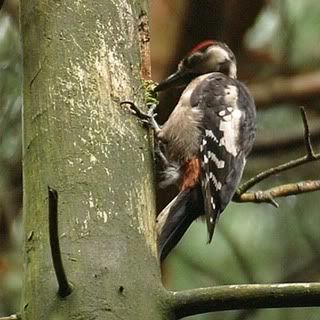 Both juvenile Great Spotted Woodpeckers (male and female) have complete red crowns with black borders at the sides. This immediately separates them from adults. Black areas are matt, not glossy, and often rather brown. There may be some dark barring on the white scapular ovals. Juveniles also have a weaker black malar stripe than adults and the post-auricular stripe is narrower and often does not quite reach the nape. Overall, white areas, particularly the cheeks, are greyer than on adult birds. Some grey streaks, occasionally light bars, cover the sides of the breast and flanks. The ventral area is pinkish, not as strong red (scarlet) as on adults. Some juveniles show a faint dark band across the chest and, more rarely, a flush of pink. The iris is brown, not as red as in adults. Juvenile males have a larger, brighter red crown than juvenile females. The black border to the red crown is also less extensive than on females. Juvenile males show the first signs of the sexually diagnostic red nape patch after the first moult at the end of summer into autumn. Juvenile females, unlike adult females, have red on the crown. This area of red is, however, smaller than on juvenile males and thus the black border is broader. The under-tail coverts are pink and less extensive than on juvenile males. The photo above shows a juvenile female in Germany (Thomas Kraft). Note the thick black border to the small red crown patch and the rather dull pink undertail. The post-auricular stripe is rather weak where it joins the nape and indeed seems to be broken: this is common in juveniles.
Great Spotted Woodpecker: adult female preening
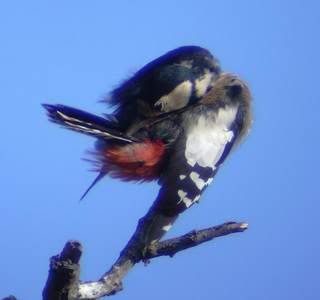 This excellent photo of an adult female Great Spotted Woodpecker preening was taken in Budapest, Hungary (Szabolcs Kokay). Even on this unusual view all the key features indicating the species can be seen: red undertail coverts and ventral area, white outer tail feathers and complete post-auricular stripe. The lack of red on the nape denotes a female.
Great Spotted Woodpecker: adult female ID
 Adult female Great Spotted Woodpeckers are essentially like males in plumage, except they lack the red on the nape. Black areas of plumage are also overall less glossy than on males and white areas often duskier. This photo of a classic adult female was taken in England (Bill Baston).
Subscribe to:
Posts (Atom)


