Can you ID this woodpecker ? Species ? Sex ? Age ? And why you think it is so ? Thanks to Rupert Pye for the photo.
Friday, 5 October 2007
Quiz Woodpecker 6
Can you ID this woodpecker ? Species ? Sex ? Age ? And why you think it is so ? Thanks to Rupert Pye for the photo.

Sunday, 30 September 2007
Quiz Woodpecker 5
 Can you state the species, sex and approximate age of the bird? Everything you need to know to do this is viewable on in photo.
Friday, 28 September 2007
Woodpeckers: juvenile moult
Juvenile woodpeckers begin a partial post juvenile moult at around the time of fledging and this continues until the autumn. In this first moult, juveniles of all ten European woodpecker species replace their primaries, rectrices and overall (body) plumage but some tertials, secondaries, primary coverts and outer greater coverts are retained. One of the ways to age 1st winter birds is the fact that there is often a moult limit in the greater coverts. For example, in Great Spotted Woodpecker where the new adult-type black inner greater coverts, contrast with the old juvenile brownish outer greater coverts. Juveniles have shorter tails than adults, due to all but the central pair of rectrices being shorter than on adults. The odd looking stunted tail of juvenile Black Woodpeckers in flight is due to this tail arrangement. Another interesting case involves Three-toed Woodpecker. Juveniles of this species sometimes begin their moult while still in the nesting cavity. Interestingly, the fifth to seventh innermost primaries are grown and replaced before the birds have fledged and thus they have never been used. This apparent rush to moult is almost certainly an adaptive feature, the result of the need of the species, as a bird of mainly northern latitudes, to complete the moulting task before the end of the short summer season. When the harsh winter season begins birds must be ready to disperse at short notice to new foraging areas, often some distance away, and a delay while moult is completed could prove fatal. For similar reasons, suspended moult occurs in local populations of other species that are prone to eruptive movements such as Fenno-Scandic and Russian Great Spotted Woodpeckers. Juveniles trapped in Fenno-Scandia after arriving from further east in late autumn apparently often exhibit signs of suspended moult in the tail and wing when compared to resident birds. Moult is then resumed sometimes as late as December.
Woodpecker moult
The moult regime of the true woodpeckers is rather unusual and this is related to the lifestyle of the family, in particular to foraging habits and to the breeding cycle. A typical European woodpecker (all except Wryneck) has ten primaries, eleven secondaries, and twelve tail feathers. Primaries 6, 7 and 8 are the longest and P10 is reduced in size in adults but is longer and broader in juveniles. Most adult woodpeckers begin a complete post-breeding moult in late spring or early summer soon after breeding has finished and this lasts into autumn. Primaries are moulted sequentially (ascendant) from P1 and the secondaries from two centres (ascendantly from S1, ascendantly and descendantly from S8). The outermost rectrices are also much shorter than the other tail feathers, the central two being the longest. These two feathers are so important as props when climbing and clinging to vertical surfaces, so they are replaced last, after the other tail feathers. Counting the central two as R1 moult starts ascendantly in pairs from R2 to R6 with R1 last. There is no pre-breeding moult for the true woodpeckers, though Wryneck has a partial pre-breeding moult. Wrynecks moult their tail feathers in reversed sequence.
Wednesday, 26 September 2007
Quiz Woodpecker 4
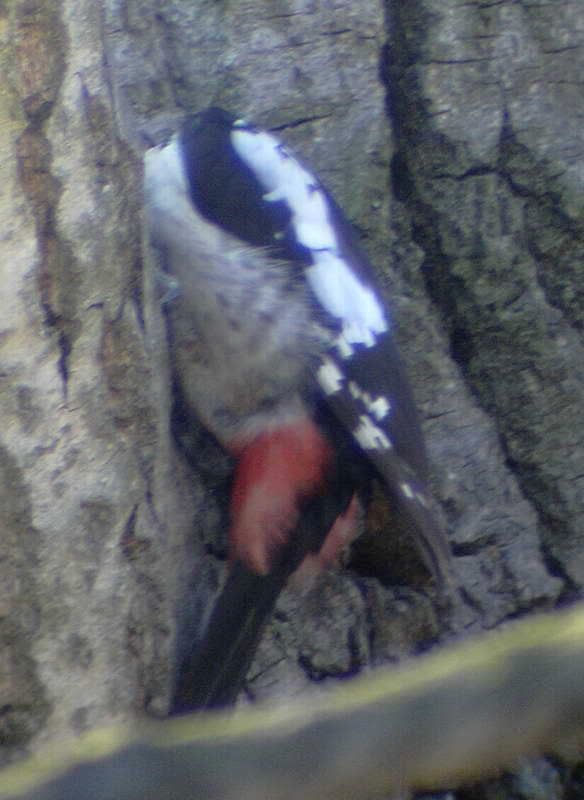 Here is the next woodpecker quiz. Can you ID it to species ? Can you say what sex the bird is ?
Monday, 24 September 2007
Holes: White-backed Woodpecker - natural hole use
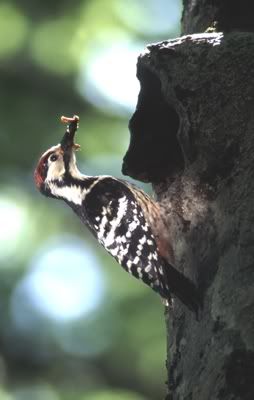 This important photo shows an adult male White-backed Woodpecker (lilfordi race) in the Abruzzo mountains, central Italy (Paul Harris). This is a very interesting shot indeed as it captures the bird using a natural tree hole as a nesting site. It is very rare for a European woodpecker (except Wryneck) to nest in a tree-hole which it did not create itself. Though the entrance is "natural" it is thought that this White-backed pair pair adapted and enlarged the cavity to suit their needs. This breeding site was also successful, note the male has food items in his beak which he is about to offer to the chicks inside the cavity.
Holes: White-backed Woodpecker
 This photo shows an adult male White-backed Woodpecker (lilfordi race) in the Abruzzo mountains, central Italy (Paul Harris). Note the almost perfectly round cavity entrance, which is typical for many species including White-backed. The paleness of the exposed wood in the entrance hole indicates the "newness" of the cavity. Indeed, woodpeckers excavate fresh, new nesting holes every spring, though occasionally an old hole will be re-used, presumably after it has proven to be a success, safe nest site. Used cavities often remain clean, as woodpeckers are hygenic breeders removing the droppings of their chicks as they grow, and thus can be re-used (by the woodpeckers who made it or by secondary cavity breeders). White-backed Woodpeckers rarely re-use a hole. This is probably because their holes often do not survive from one spring to the next as they are invariably made in very rotten trees which decay rapidly and become unstable.
Subscribe to:
Posts (Atom)