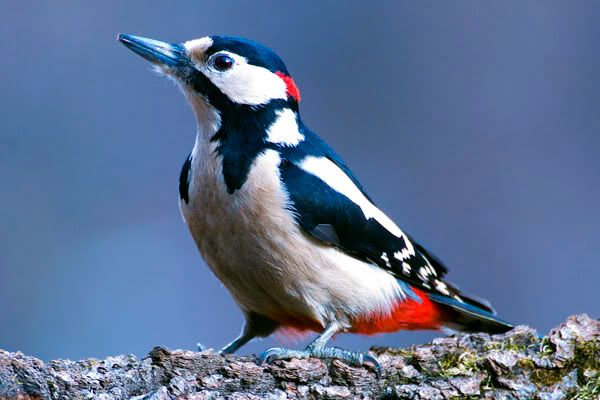
 The main distinction between adult male and female Great Spotted Woodpeckers is the presence of a bright red nape patch on the male, which the female lacks. The males black crown often has a rather bluish sheen and, as with most woodpecker,s the male’s bill is heavier though this is not really noticeable in the field. The photo here is of an adult male in Hungary (László Nehézy)
Tuesday, 11 September 2007
Great Spotted Woodpecker: adult male ID
The main distinction between adult male and female Great Spotted Woodpeckers is the presence of a bright red nape patch on the male, which the female lacks. The males black crown often has a rather bluish sheen and, as with most woodpecker,s the male’s bill is heavier though this is not really noticeable in the field. The photo here is of an adult male in Hungary (László Nehézy)

Great Spotted Woodpecker: general ID
 Measurements: Length 21-23 cm. Wingspan 34-39 cm. Taking all European species into account Great Spotted is a medium sized woodpecker. It is the same size, shape and structure as Syrian Woodpecker and thus between the larger White-backed and smaller Middle Spotted Woodpecker. The nominate race major is described here. This is the woodpecker with which most Europeans are familiar. It is a typical Dendrocopos species, essentially black and white, one of the so-called “pied" woodpeckers. The upper-parts from mantle to rump are essentially glossy black and marked with white. The inner scapulars are black, outer scapulars and inner greater and median coverts white and combine to produce large white ovals on the “shoulders". These white oval patches show particularly well in flight. The chin and throat are white or cream. The breast, belly and flanks are also white, sometimes slightly buff, and generally lack streaking. In Europe any grey or rusty tones are usually a result of contact with trees. The under-tail coverts and ventral area are scarlet and there is often a sharp demarcation between this area and the white lower belly: the red does not gradually fade or merge with the white it does on some other species. A long, black malar stripe runs from the bill across the cheek to the side of the neck, where it joins the post-auricular stripe and a lateral stripe running from the upper breast sides and a short joining stripe from the mantle and shoulder. These black lines meet below the ear-coverts. The post-auricular stripe continues across the face below the ear-coverts and reaches the nape. Thus, an enclosed white area is formed on the side of the face. No other European Dendrocopos woodpecker has this enclosed white face patch feature, as the post-auricular stripes on other species do not reach the nape. The forehead and lores are white and the nasal tufts black. The crown is glossy black. A black linking line runs from the nape down the hind-neck to the mantle. This stripe is joined at on each side by black post-auricular stripe thus birds seen from rear show a black "cross" on hind-neck. The upper-tail is matt black and under-tail a dull black-brown. The outer-most rectrix (T6) is black but hidden under the tail-covets. The adjacent two rectrices are white and maybe barred with black (in Syrian it is the reverse, the rectrices are mainly black and dotted with white). There is often some white on the third rectrix but all other tail feathers are plain black. The upper-wing is matt black and the wing-coverts glossy black. The under-wing coverts are smoky white with some black spots, wing feathers grey-black and heavily barred with white-buff. The flight feathers are black and dotted with rows of 5 or 6 white spots that almost form bars. The stocky, dagger-shaped bill is broad at the base and can comprise 60% of the skull length. It is grey to charcoal in colour with the base of the lower mandible paler. The eyes are usually dark red and the legs grey-olive. The photo here is of an adult male, taken in the UK (Bill Baston).
Monday, 10 September 2007
Three-toed Woodpecker: male alpinus race photo
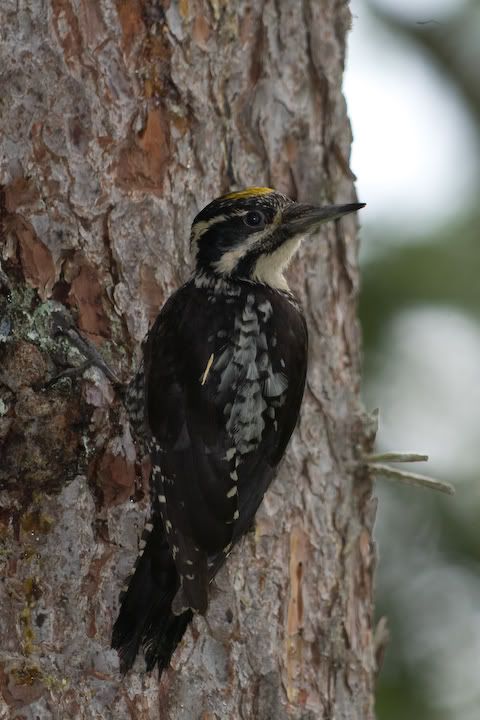 This photo of a classic alpinus race male bird was taken at Hoher Ifen, Kleines Walsertal, Austria on 13.06.2007 (Ralph Martin). Note the barred white back and yellow on the crown
Three-toed Woodpecker: female alpinus race photo
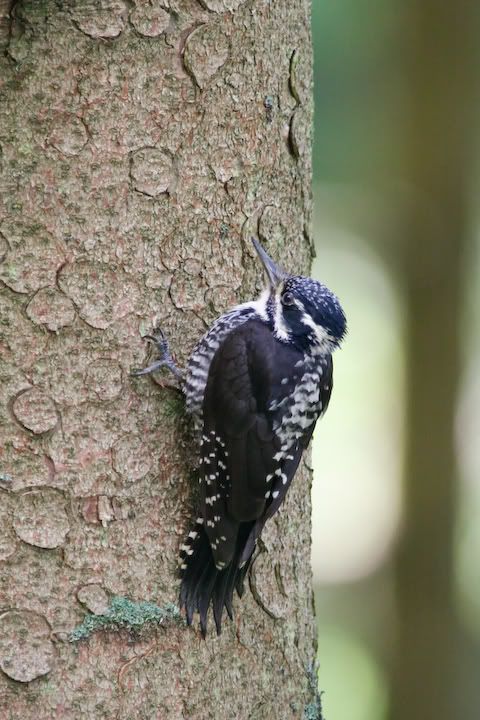 This photo from Schwarzer Grat, Lkr. Ravensburg, SW Germany was taken on 24.06.2007 (Ralph Martin). It shows a classic alpinus race bird. Note the white back is barred with black and the heavily barred breast, belly and flanks. The lack of yellow on the crown indicates a female.
Three-toed Woodpecker: atypical adult male alpinus
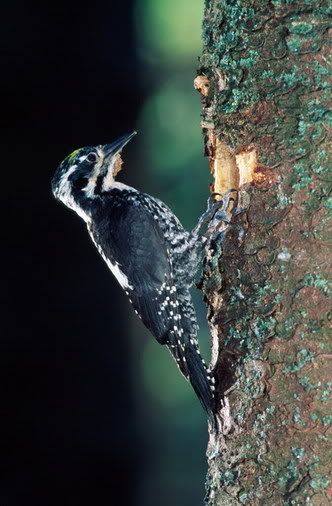 This adult male alpinus, photographed in Slovakia (László Novák/Kármán Balázs) shows a very white, almost unbarred back patch. This is more typical of birds of the northern nominate race tridactylus. But note the very dark barring on the underparts which is typical of alpinus.
Three-toed Woodpecker: variation in plumage
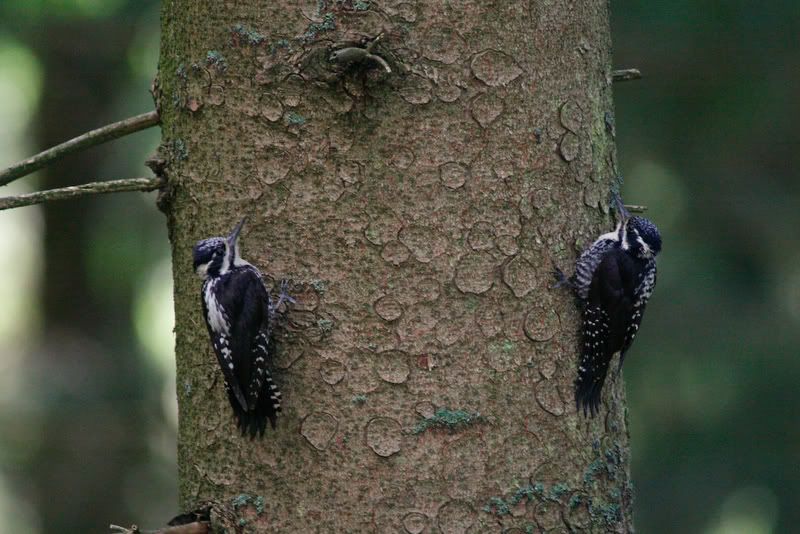 There is marked individual variation in the plumages of Three-toed Woodpeckers. Both within, and between, populations of the two races. The main clinal variations run in a north-south direction. Northern birds are generally lightly in colour and smaller in size than southern birds. Differences in the back pattern of the two European races are well known, but back patterns can vary significantly within each race. In Central Europe in particular the backs of birds of the alpinus race can vary greatly. Most typically show dark barring on the white of the back, though this barring varies from broad continuous bands, to broken dusky bands, to vague dusky smudges, to thin faint continuous or broken lines, to fine almost invisible vermiculations. A few birds may show vertical streaks or chevrons, of varying intensity, rather than horizontal barring. In addition, some birds of this race resemble nominate in that they completely lack barring on the white back panel. There are several populations that are almost intermediary in plumage between classic tridactylus and alpinus. Poland is a good country in which to study Three-toed Woodpecker plumages as both races occur. In the Bialowieza forest and rest of northeast Poland birds are regarded as tridactylus, but they differ from Scandinavian birds (which are the same race) in several respects. For example, they are darker and have heavy black spotting on the white back panel. In fact, in most of the features and darkness of plumage they resemble alpinus. They most resemble Scandinavian birds in terms of size and in having dark flecks and spots on the flanks and belly rather than bars. In some areas of the Carpathians (in southern Poland, Slovakia and Romania) and in the Alps (in southern Germany) alpinus occurs but some birds do not show the barred backs. Locally, most birds can lack barring on the white panel on their backs. Sometimes birds show single blackish spots as they often do in northeast Poland. Other birds may have the upper part of the white back panel bordered by a dark horizontal stripe. All in all, it is not unusual to see alpinus race Three-toed Woodpeckers in the Carpathians which more closely resemble the northern European tridactylus race in back pattern. In Austria, Romania, the Czech Republic and Slovakia I have observed alpinus birds with the classic densely barred flanks and under-parts of that race but which showed only faint grey barring on a clean white back panel. It might be the case that inter-grades between the two European races occur, though there is no firm evidence to support this. Perhaps the large distances that Three-toed Woodpecker sometimes travels, when in search of winter foraging, means that the two races encounter each other more often than their mapped geographical ranges may suggest? Birds of the tridactylus race in Fenno-Scandia and European Russia periodically move to the west and south and it is reasonable that it is these birds which enter the range of the more sedentary alpinus race rather than the other way round, if indeed the two sub-species do meet. The forests of the Carpathians are located between the main distribution zones of the two races and may be a zone of contact. Or perhaps atypically marked birds are relics from a time when the range of the species stretched right through from northern to southern Europe? The very interesting photo above was taken at Schwarzer Grat, Lkr. Ravensburg, SW Germany on 24.06.2007 (Ralph Martin). It shows two females, one a classic alpinus (on the right), the other a non-typical bird with an unbarred white back (on the left) which resembles the northern nominate race.
Three-toed Woodpecker: alpinus flight photo
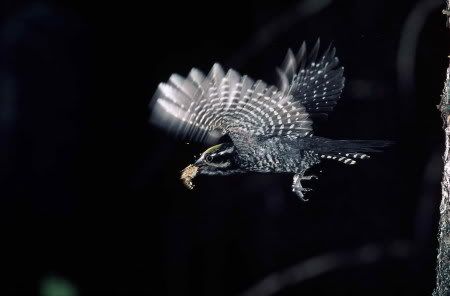 This adult male alpinus race Three-toed Woodpecker was photographed in Slovakia (László Novák/Kármán Balázs). The back pattern cannot be seen on this flight view but note the heavily barred underbody and overall very dark plumage.
Subscribe to:
Posts (Atom)